
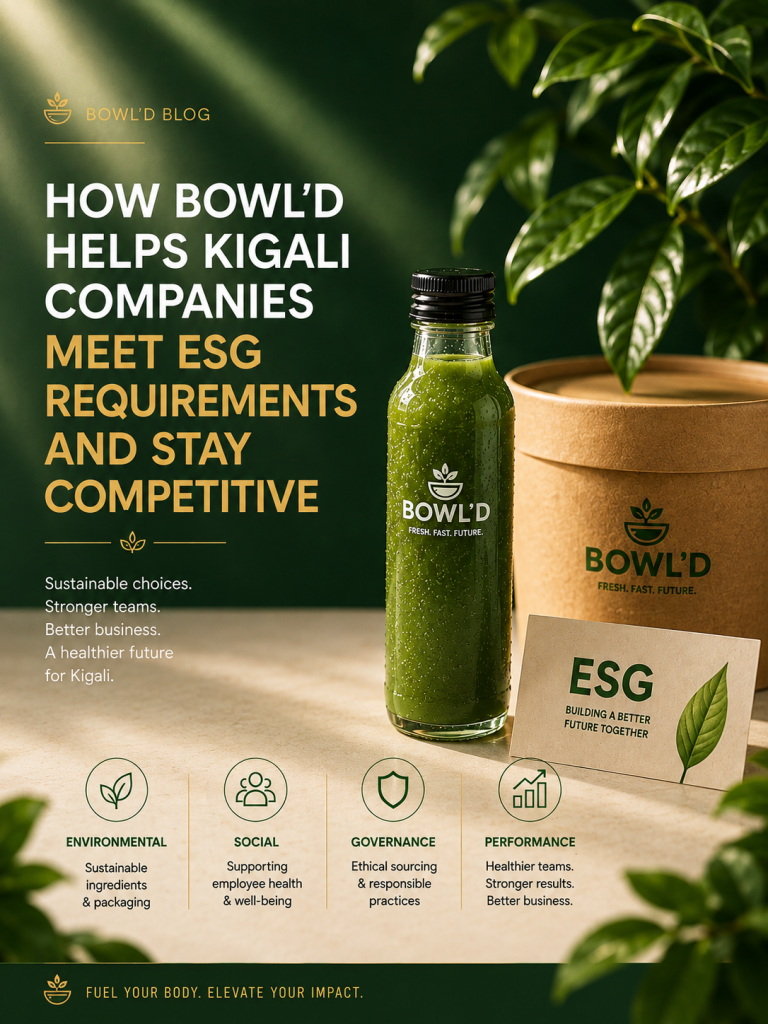
In today’s business world, ESG is no longer a buzzword reserved for large multinationals or investor presentations. Environmental, Social, and Governance performance is becoming a practical requirement for companies that want to win contracts, attract capital, recruit top talent, and build long-term resilience. For Kigali companies, this shift is especially important. Rwanda is steadily strengthening its sustainability and disclosure ecosystem, while international clients, investors, and partners increasingly expect proof that businesses are operating responsibly.
This is where Bowl’d comes in. As a groundbreaking healthy food subscription and wellness shots company in Kigali, Bowl’d is more than a convenient lunch solution. It is a business tool that can help companies improve employee wellbeing, demonstrate responsible procurement, reduce operational friction, and build a stronger ESG story in a way that is visible, measurable, and easy to implement. Bowl’d’s subscription model is built around fresh bowls, fruit bowls, smoothies, healthy snacks, and wellness shots delivered in Kigali to corporate offices, coworking spaces, retail hubs, and institutional environments.
ESG starts with the workforce
For most companies, the “S” in ESG is the easiest to overlook and the hardest to fake. Social performance is not only about philanthropy or community projects. It is also about how a company treats its people every day. Food is a direct part of that story. When employees are consistently fed well, they are more energized, more focused, and more likely to experience better morale and workplace satisfaction.
Bowl’d helps companies support staff well-being through structured meal subscriptions that remove the guesswork of lunch. Instead of employees skipping meals, relying on low-quality convenience food, or spending excessive time searching for lunch options, teams receive healthy, fresh food on a reliable schedule. That small change can improve daily productivity while showing that the company takes employee welfare seriously.
In ESG terms, this matters. A company that invests in nutritious food access for its team is making a practical social investment, not just a symbolic gesture. That commitment can strengthen internal culture, improve retention, and support employer branding in a competitive talent market.
Healthy food as a business advantage
Companies often think of wellness programs as optional perks. In reality, they are increasingly part of operational excellence. International clients, development partners, and sophisticated local buyers want to work with companies that manage people well and think long term. A workplace that prioritizes healthy meals signals discipline, care, and modern management.
Bowl’d’s subscription approach also helps businesses move from ad hoc spending to structured employee support. This is important because ESG is increasingly about systems, not one-off gestures. A recurring healthy food program is easier to document, easier to communicate in sustainability reports, and easier to scale across teams. It also creates a repeatable internal policy that can support broader human capital strategies.
For companies preparing bids, partnerships, or impact reports, this can become a useful ESG story. Our team wellbeing is not an afterthought, but part of how we operate.
Environmental value through smarter consumption
The “E” in ESG is often associated with energy, emissions, waste, and sourcing. Food service plays a role in all of these areas. Bowl’d can help companies strengthen their environmental profile by encouraging more efficient food planning and reducing the waste associated with random individual meal purchases.
Subscription-based food service tends to create better predictability. When demand is known in advance, food preparation and delivery can be managed more efficiently. That can mean fewer unnecessary purchases, less spoilage, and more responsible use of ingredients. For companies, this supports the broader goal of doing more with less.
Bowl’d also fits into a wider sustainability narrative that is becoming increasingly relevant in Rwanda. Rwanda’s ESG frameworks and sustainability disclosure direction show that businesses are expected to think more carefully about responsible operations and transparent reporting. Companies that can point to concrete workplace sustainability initiatives have a stronger foundation when engaging with ESG-conscious stakeholders.
Better governance through structure and consistency
The “G” in ESG is often associated with board oversight, compliance, and internal controls. While food may seem far removed from governance, the way a company manages employee welfare programs reflects its internal discipline. A structured meal subscription is easier to oversee than informal reimbursements, inconsistent canteen arrangements, or discretionary food spending with unclear controls.
Bowl’d gives companies a simple, organized service model that can support procurement transparency and budget clarity. That matters for finance teams, HR departments, and operations managers who need predictability. It also helps companies create a cleaner internal record of how they invest in employee wellbeing, which can be useful for management reporting and ESG documentation.
Strong governance is not just about avoiding risk. It is about building systems that are repeatable, auditable, and scalable. Bowl’d supports that mindset by turning lunch and wellness support into a managed business process rather than a daily inconvenience.
Why this matters for Kigali’s competitiveness
Kigali companies are not competing in isolation. They are competing for contracts with multinational firms, regional institutions, development organizations, and local customers who are becoming more aware of sustainability and wellness. ESG expectations are increasingly shaping procurement decisions, supplier standards, and partnership criteria. Companies that can demonstrate practical ESG behavior will often have an edge.
Bowl’d helps companies build that edge in a very visible way. A firm that provides healthy lunches and wellness shots for employees can speak credibly about staff care, operational responsibility, and modern workplace culture. That can be especially powerful during client visits, investor conversations, pitch decks, and annual reporting.
In a market where image matters, but authenticity matters more, food is one of the most believable places to start. It is tangible. Employees feel it every day. Visitors notice it. And leadership can measure it.
ESG that people can actually experience
One of the biggest problems with ESG is that it can become abstract. Companies write reports, set targets, and publish policies, but employees may not feel the difference. Bowl’d helps close that gap by making ESG visible at the point of use. When a company chooses healthy, consistent meals for its team, it turns sustainability into something practical.
That is powerful because people trust what they experience. An employee who receives quality food at work understands that the company is investing in wellbeing. A client who sees a thoughtful workplace setup understands that the business pays attention to detail. An ESG reviewer or partner can see that the company’s values are not just printed on a website.
A competitive future starts with daily choices
The companies that thrive in the ESG era will not only be the ones with the best policies. They will be the ones that integrate responsible practices into everyday operations. Bowl’d helps Kigali businesses do exactly that by embedding nutrition, wellness, and consistency into the workday.
For businesses in Kigali, Bowl’d is more than a meal provider. It is a strategic partner in building a healthier workforce, a more responsible operation, and a stronger ESG profile. In a world that increasingly rewards sustainable, people-centered, and well-governed enterprises, that is a competitive advantage worth investing in.